How this page was served
This page is not a static file. The function rendered it for your request, just now, in the execution environment below. Refresh a few times: with no session affinity, the environment ID can change, and the request count goes up.
Live facts about this request
| Execution environment | 0e0bd6e8 |
|---|---|
| Region | us-east-1 |
| This request was | warm this environment had served requests before |
| Environment started | 2026-10-21T14:46:44.012Z (up 57 min 55 s) |
| Requests served by this environment | 274 |
| Games run here / copies / spectators | 0 / 0 / 0 |
| host | mbnd5msy2zhmrrzd.3t7.lambda-web.us-east-1.on.aws |
| user-agent | Mozilla/5.0 AppleWebKit/537.36 (KHTML, like Gecko; compatible; ClaudeBot/1.0; +claudebot@anthropic.com) |
| CloudFront | yes, request ltnY0nggCJ9Jm-6cu9I0z59AnkLS_BuSASqOfI9yiuz0JRssSEqs9g== via 2.0 a10a7384ec53ee4c3ce439b9f86213b2.cloudfront.net (CloudFront) |
| x-forwarded-for | 216.73.217.x, 3.172.126.x |
| Render time | 1.15 ms (also in the server-timing header) |
Counters are per execution environment and reset when it starts. Addresses have their last part hidden.
Architecture
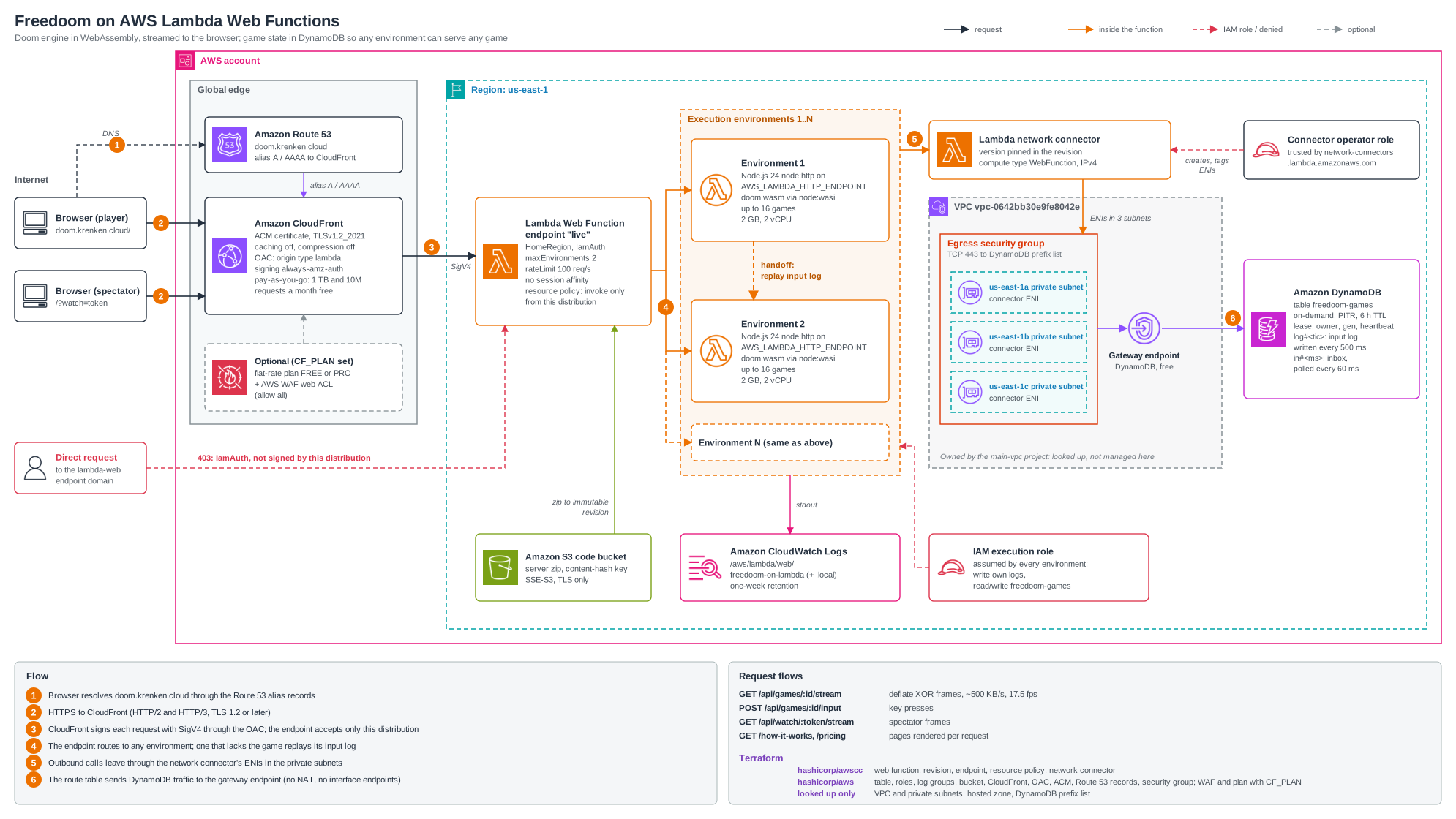
Step by step
- The endpoint routes your request to an execution environment.
Your browser called CloudFront, which forwarded the request to the Web Function endpoint (
mbnd5msy2zhmrrzd.3t7.lambda-web.us-east-1.on.aws, endpointlive). Lambda picked an execution environment for it, here0e0bd6e8. There is no session affinity: the next request, even from this tab, may land on a different one. - A plain
node:httpserver answers. A Web Function runs an ordinary HTTP server. The runtime setsAWS_LAMBDA_HTTP_ENDPOINTand the server listens on it, no handler wrapper:server/index.js:40-41 // On Lambda the runtime sets AWS_LAMBDA_HTTP_ENDPOINT. Locally, loopback only. const [HOST, PORT] = (process.env.AWS_LAMBDA_HTTP_ENDPOINT || `127.0.0.1:${process.env.PORT || 3000}`).split(':');server/index.js:690-690 server.listen(Number(PORT), HOST, () => console.log(`freedoom-lambda-web-functions environment ${ENV_ID} listening on http://${HOST}:${PORT}`)); - The router reaches this route and renders the HTML.
The request handler counted your request, matched
/how-it-worksand calledrenderHowItWorks(). Theserver-timingresponse header carries the render time.server/index.js:561-571 if (req.method === 'GET' && url.pathname === '/how-it-works') { const t0 = performance.now(); const html = renderHowItWorks(req, { t0, cold, environment: ENV_ID, region: process.env.AWS_REGION || 'local', metrics: metrics.snapshot(), games: games.size, followers: followers.size, spectators: spectatorCount(), }); res.writeHead(200, { 'content-type': 'text/html; charset=utf-8', 'cache-control': 'no-store', 'server-timing': `render;dur=${(performance.now() - t0).toFixed(2)}`, }); res.end(html); - For the game, the same server does everything else.
- The page and its script are files served from a map:
server/index.js:520-529 const STATIC = { '/': ['index.html', 'text/html; charset=utf-8'], '/index.html': ['index.html', 'text/html; charset=utf-8'], '/client.js': ['client.js', 'text/javascript; charset=utf-8'], '/qrcode.mjs': ['qrcode.mjs', 'text/javascript; charset=utf-8'], // qrcode-generator 2.0.4, MIT '/pricing': ['pricing.html', 'text/html; charset=utf-8'], '/pricing.js': ['pricing.js', 'text/javascript; charset=utf-8'], '/pricing-model.js': ['pricing-model.js', 'text/javascript; charset=utf-8'], '/architecture.svg': ['architecture.svg', 'image/svg+xml'], // copied from docs/architecture.svg by make diagram }; - The game runs here, in WebAssembly, and frames stream back on one long response:
server/index.js:411-414 // One frame on the wire, inside a single deflate stream per connection: // u32 tic | u8 flags (bit 0: palette follows) | 768 bytes palette | w*h pixels XOR previous frame // XOR against the previous frame turns unchanged pixels into zeros, which deflate // compresses to almost nothing. - Web Functions don't run WebSockets, so key presses come back as separate POSTs. If the game runs elsewhere, the input goes to a DynamoDB inbox:
server/index.js:674-677 const local = games.get(id); try { if (local) local.offer(cid, seq, keys); else await store.putInbox(id, cid, seq, keys); - Only one environment runs a game at a time. The owner writes its input log and heartbeat in one transaction that only succeeds while it holds the lease:
server/store.js:200-225 async heartbeat(id, me, gen, { tic, seqs, firstTic, events }) { const items = this.logPut(id, firstTic, events); items.push({ Update: { TableName: this.table, Key: this.key(id, 'lease'), UpdateExpression: 'SET heartbeatAt = :now, tic = :tic, seqs = :seqs, expiresAt = :exp', ConditionExpression: '#o = :me AND gen = :g AND attribute_not_exists(want)', ExpressionAttributeNames: { '#o': 'owner' }, ExpressionAttributeValues: { ':now': toAttr(Date.now()), ':tic': toAttr(tic), ':seqs': toAttr(seqs), ':exp': toAttr(expires(GAME_TTL_S)), ':me': toAttr(me), ':g': toAttr(gen), }, ReturnValuesOnConditionCheckFailure: 'ALL_OLD', }, }); try { await this.client.send(new this.ddb.TransactWriteItemsCommand({ TransactItems: items })); return { ok: true }; } catch (e) { if (e.name !== 'TransactionCanceledException') throw e; const reason = e.CancellationReasons?.[items.length - 1]; const current = leaseFrom(reason?.Item); if (current && current.owner === me && current.gen === gen && current.want) return { want: current.want }; throw new LeaseLost(`lease for ${id} moved to ${current?.owner} gen ${current?.gen}`); } } - When a stream lands on another environment, that one takes the game over and rebuilds it by replaying the input log. The engine is deterministic, so it lands on the same tic:
server/index.js:219-227 async function rebuild(id, lease, handoff) { const t0 = performance.now(); const engine = new DoomEngine(); const events = await store.readLog(id); const { palette } = await replay(engine, events, lease.tic); const info = { replayedTics: lease.tic, replayMs: Math.round(performance.now() - t0), handoff }; console.log(JSON.stringify({ msg: 'rebuilt', game: id, ...info, events: events.length })); return start(id, engine, lease, { ...info, palette }); }
- The page and its script are files served from a map:
Rendered by server/howitworks.js. See pricing for what running this costs.